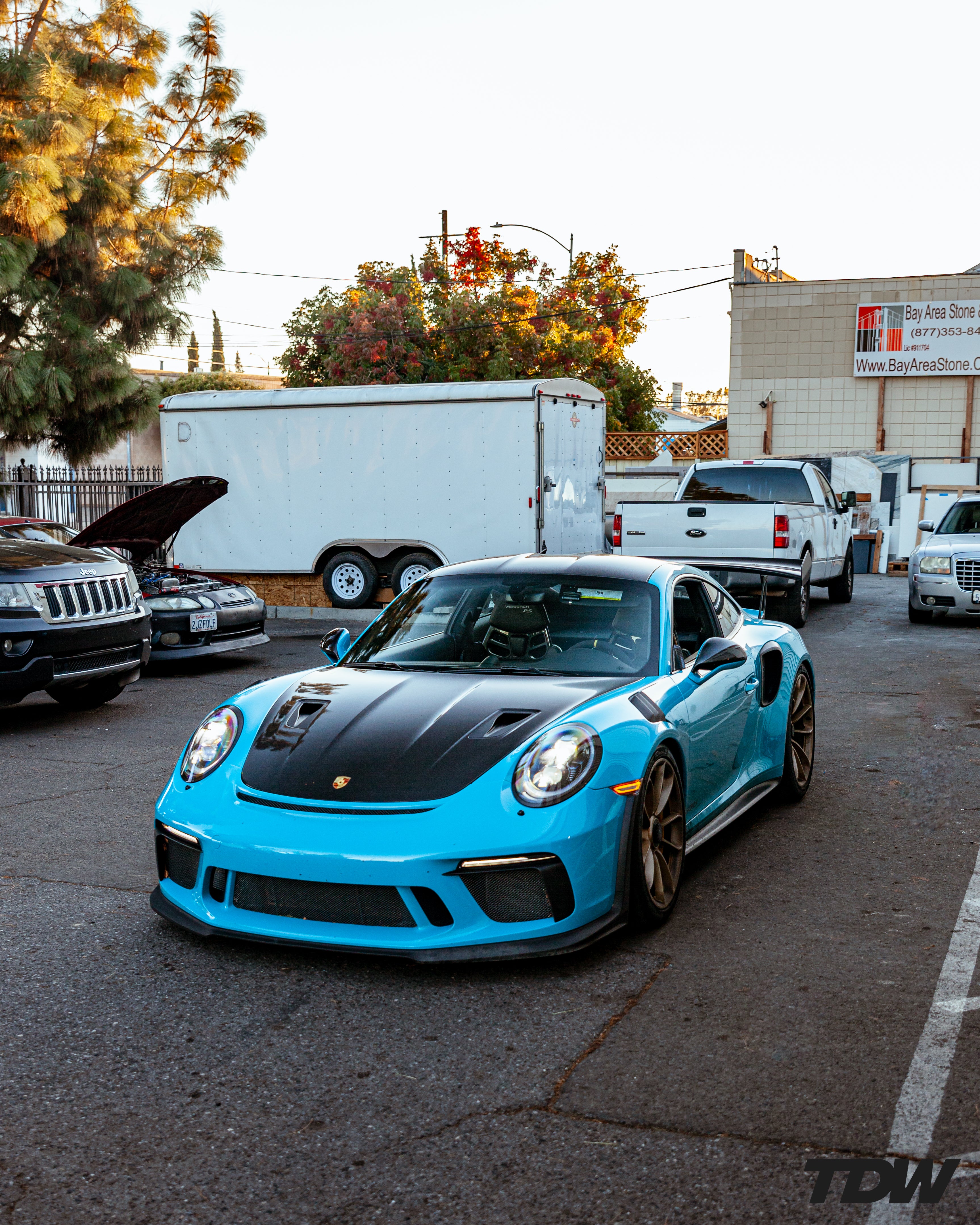
A centerlock wheel is held on by one large nut instead of five lugs. It comes from racing, where it saves seconds in a pit stop. On a street car it saves nothing, and it asks more of whoever takes the wheel off. Many tire shops won't touch them.
Porsche fits centerlocks to the 911 GT3, GT3 RS and GT2 RS, the 718 Cayman GT4 RS and Spyder RS, and some Turbo models. If yours has them, this is what should happen at every tire change.
What Porsche says
Porsche's technical bulletin on centerlock wheel nuts, last revised in April 2026, sets the rules for technicians (the bulletin, as filed with NHTSA). In plain terms:
- The wheel is off the ground when the nut is tightened. That lets the wheel center itself on the hub.
- No impact guns. Not to loosen, not to tighten. They can damage the nut and hub in ways that don't show right away.
- A calibrated torque wrench, pulled in one smooth motion. Torque multipliers are no longer approved.
- The parking brake never holds the car. It isn't built for that force. The usual way is a second person on the brake pedal.
- Clean surfaces and the right lubricant. The wheel and hub faces are cleaned, and the specified lubricant goes on the contact surfaces of the nut and wheel.
- New parts get tightened more than once. If the nut, hub or wheel is new, the nut is tightened to full torque, loosened and tightened again, three times.
On current GT cars the final torque is 600 Nm, about 443 lb-ft. That's roughly four times what a Porsche lug bolt gets, which is why the wrench is about four feet long.
Questions worth asking any shop
- Do you have the centerlock socket and a torque wrench that reaches 600 Nm?
- Will the car be in the air when you torque the wheels?
- Who's holding the brake pedal?
If the answers come slowly, take the car somewhere else. A centerlock nut that's wrong can damage a hub, and a hub costs far more than a set of tires.
And the tire itself
GT wheels are wide, the tires are stiff, and the finish marks easily. We mount them on a leverless changer, so no pry bar touches the rim, and balance them on a Hunter Road-Force machine, which finds the vibration a normal balancer misses. Then the wheels go back on by Porsche's procedure.